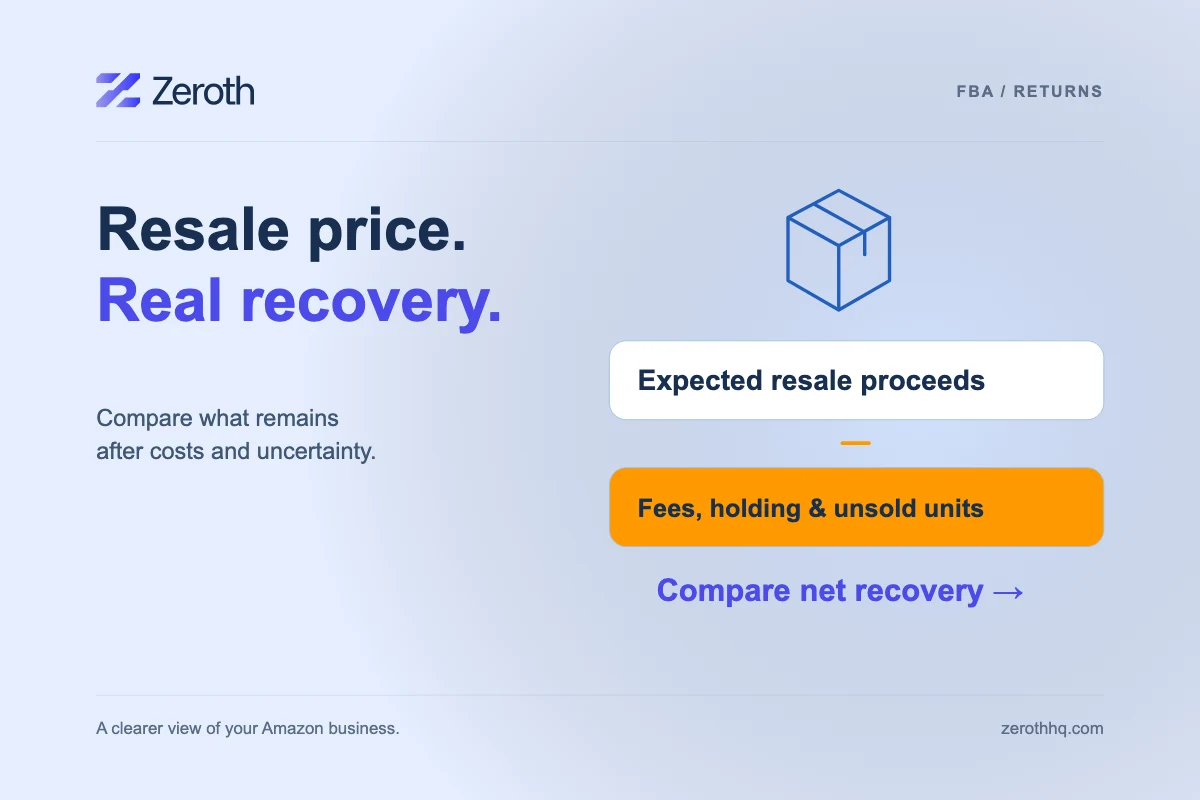
A returned item with a $24 resale price does not recover $24 for your business. Selling costs, processing, time in inventory, and the possibility of no sale all affect what remains. Before choosing a recovery route, compare the cash you expect to recover from the decision you can make today.
This is Zeroth’s planning method for US FBA sellers, with an explicitly hypothetical example. It is not an estimate of your ASIN’s fees, eligibility, or likely sales.
Start with the right service and fee trigger
Amazon’s current US help groups Restore to New and Sell as Used under Grade and Resell. They are separate opt-in services. The overview says the processing charge applies when an item is successfully relisted, with no processing charge for an unrecoverable item. Amazon’s Grade and Resell overview
For sellers already enrolled in Restore to New, Amazon identifies September 30, 2026 as the effective date for that processing charge. It separately describes automatic repackaging, so do not assume every packaging intervention is the optional restoration service. Amazon’s Restore to New guidance
Sell as Used eligibility depends on the returned unit, including product type, condition, price threshold, and fulfillment-center participation. Enrollment alone does not guarantee relisting. Its help page places the processing fee at relisting and says storage charges resume after a used listing is created. Amazon’s Sell as Used guidance
The practical distinction is relisted versus sold. For the enrollment comparison below, model one unit that qualifies for successful relisting. The processing cost is incurred at that stage in both the later sold and unsold outcomes. Do not multiply that cost only by the chance of a later sale. If reviewing a unit that has already been relisted, treat its paid processing fee as sunk and compare only the cash flows remaining from today.
Compare the cash flows that still depend on your choice
Zeroth analysis: choose a review horizon, such as 60 days, and compare both routes at that same horizon. Build a separate row for each condition grade when the expected price or selling speed differs.
Record these inputs:
- Resale price and revenue-based charges for that offer.
- Fulfillment and other costs incurred if it sells.
- An allowance for expected subsequent return losses, without counting the same cost twice.
- Processing costs incurred when it is relisted.
- Expected holding costs across the review period.
- Probability of a sale during that period.
- Net fallback recovery if it remains unsold at the end.
- Net recovery from the alternative route available now, after that route’s costs.
The original product purchase cost still belongs in your business’s overall profitability. If it is already incurred and identical across the choices, however, subtracting it from both sides does not change which recovery route is better. Keep this incremental decision worksheet separate from a full profit report. Our minimum-price contribution guide explains how to build a broader cost-based price floor.
Use the following relationship:
Expected net recovery = sale probability × net proceeds if sold + unsold probability × net fallback recovery − relisting processing cost − expected holding cost.
Here, “net proceeds if sold” is after sale-dependent charges, but before the processing and holding costs shown separately. The fallback figure must also be net of its own costs. This avoids subtracting the same expense twice.
A hypothetical 60-day comparison
Assume one unit has already qualified for relisting. Every number below is invented for illustration; none is an Amazon rate quote or a promised recovery outcome.
| Input | Assumption |
|---|---|
| Used resale price | $24.00 |
| Revenue-based charge | 15% of resale price |
| Fulfillment cost if sold | $4.00 |
| Expected subsequent return-loss allowance if sold | $1.00 |
| Relisting processing cost | $1.80 |
| Expected holding cost over the review period | $0.60 |
| Probability of sale within 60 days | 65% |
| Net fallback recovery if unsold | $1.00 |
| Net recovery from the alternative route now | $6.00 |
Net proceeds in the sold outcome are $24 × 0.85 − $4 − $1 = $15.40.
Expected net recovery is 0.65 × $15.40 + 0.35 × $1 − $1.80 − $0.60 = $7.96. Under these assumptions, resale leads the $6 alternative by $1.96 per successfully relisted unit.
That is a modest cushion, not a reason to enroll an entire catalog. The model excludes fixed overhead and the time value of money. Add incremental advertising, handling, taxes, or other costs where relevant to your comparison, using the same basis for both routes.
Find the assumptions that reverse the decision
Keep all other assumptions fixed and reduce the sale probability to 50%. Expected recovery becomes 0.50 × $15.40 + 0.50 × $1 − $2.40 = $5.80. The alternative now leads by $0.20.
At the original $24 price, the probability needed to match $6 is:
($6 + $2.40 − $1) ÷ ($15.40 − $1) = about 51.4%.
That threshold is a question for your own evidence: can comparable units in the same condition reasonably sell within the chosen period at that price? A new-item sales rate is not automatically a used-item sales forecast.
Price also matters. At an $18 resale price and the original 65% probability, net proceeds if sold fall to $10.30. Expected recovery becomes 0.65 × $10.30 + 0.35 × $1 − $2.40 = about $4.65. Lower prices may change the probability of selling; rerun both inputs together instead of assuming demand stays fixed.
Run a small, measurable review
Before acting, confirm the specific ASIN and returned-unit eligibility in Amazon’s current guidance and your account. Save the service selected, expected condition, price inputs, fees, fallback route, and review date. A spreadsheet row should make it possible to reconstruct the decision later.
For a proposed batch, do not apply the per-relisted-unit result to every return. Separate units expected to qualify from those that may remain unrecoverable, and model the latter’s route independently. Confirm that each alternative in the worksheet is actually available to you.
At the review date, reconcile how many units were relisted, sold, returned again, or remained unsold. Compare actual charges with your estimates. Refresh the sale probability using comparable cohorts and record how many observations support it. If you lack that evidence, use a range and a small exposure limit instead of presenting one precise forecast as fact.
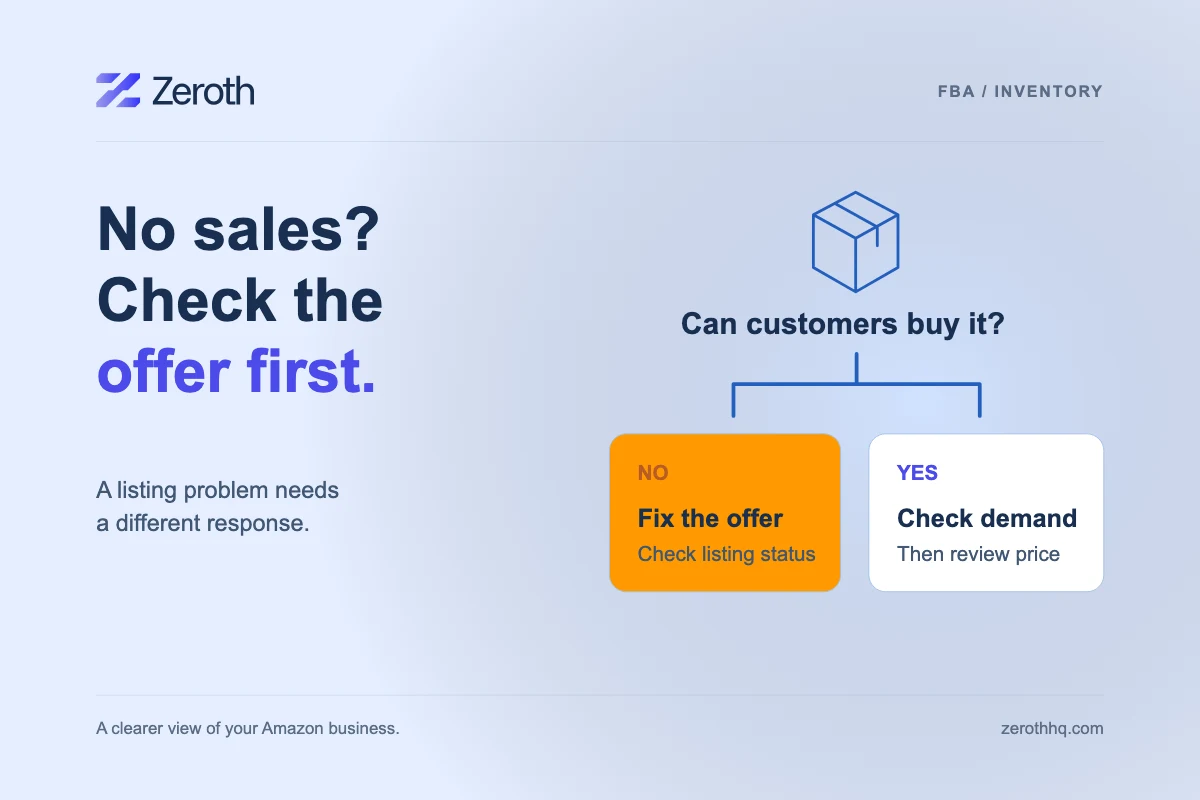
Finally, investigate an unsold offer before cutting its price. If customers cannot buy it, demand is not the only issue. Use our stranded-inventory triage guide to separate an unavailable offer from a slow seller, then decide whether the recovery assumptions still hold.
Sources & further reading
- Amazon US help: FBA Value Recovery, Grade and Resell ↗Checked November 15, 2026
- Amazon US help: FBA Sell as Used ↗Checked November 15, 2026
- Amazon US help: Restore to New ↗Checked November 15, 2026
Sources support reported facts; practical recommendations are Zeroth’s analysis. Amazon features and availability can change.