Amazon’s November 10, 2026 seller update describes using Amazon Quick, the Selling Partner plugin, and the Amazon Ads MCP Server across holiday planning and execution. The plugin connects seller information to AI tools; the Ads connection can support campaign actions. Amazon asks sellers to inspect proposed changes and the data behind them before approving. Amazon’s holiday update
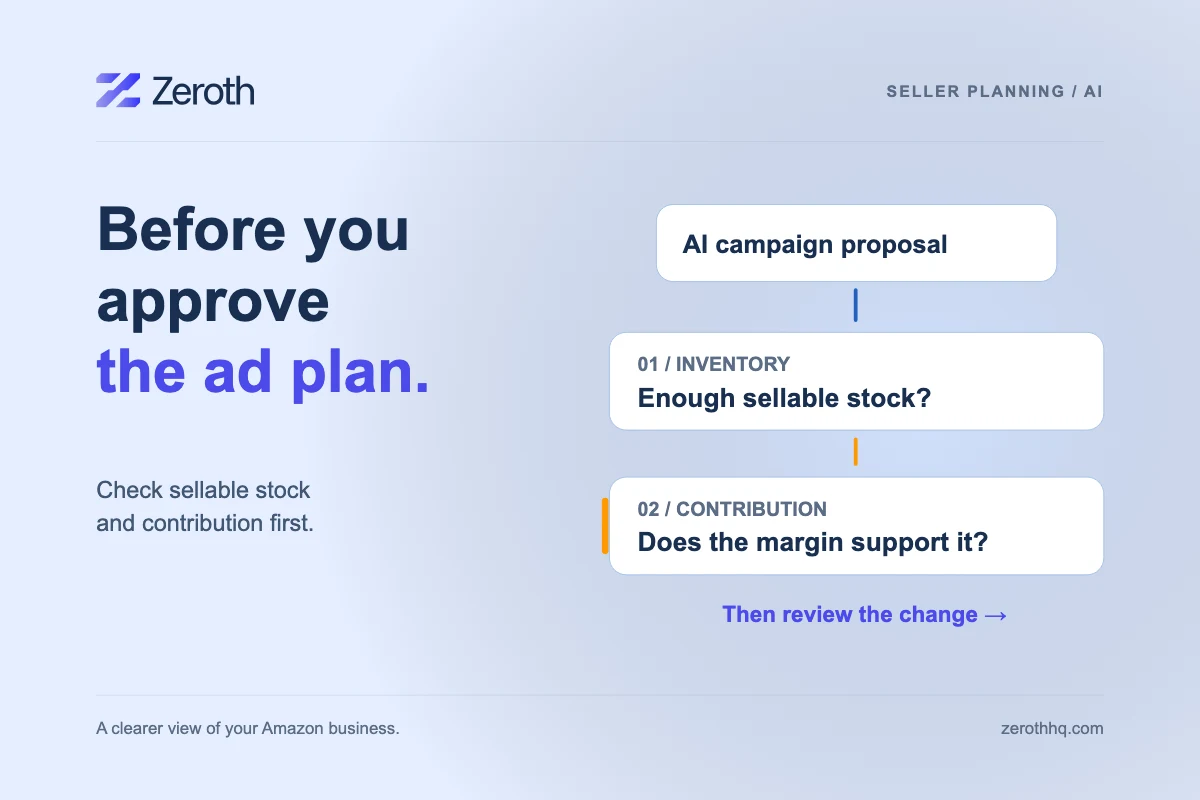
For a US seller, the practical question is whether a proposed advertising change fits the inventory and contribution available to support it. Below is Zeroth’s suggested decision process, with an invented example. It does not depend on granting an assistant permission to change your account.
What changed, and who can use it?
The November post is holiday guidance, not a new fee, compliance deadline, or universal product launch. Amazon’s September 23, 2026 announcement describes the Selling Partner plugin as a beta for sellers in its US stores, with international expansion to follow. Amazon’s plugin announcement
The Ads tool has separate access requirements. Its February 2, 2026 announcement says the open beta is available globally to Amazon Ads partners with active API credentials. A seller account alone therefore should not be treated as proof of access to that integration. Amazon Ads eligibility
Check the options actually available to your account. If you lack access, the worksheet below can still be completed from your inventory and advertising reports. This guide does not assume the beta includes every account, feature, or workflow, and it is not a setup tutorial.
Start with a decision sheet for one ASIN
Zeroth analysis: a useful recommendation should expose its inputs before proposing a change. Choose one product and record:
- Identity and time: marketplace, SKU, ASIN, campaign IDs, reporting period, timezone, and when each report was retrieved.
- Stock you can sell: currently available units, separate reserved or unavailable units, and inbound quantities with their expected availability dates.
- Demand assumptions: recent daily unit sales, the period used to calculate them, and a separate promotional-demand scenario.
- Economics: selling price, product cost, fulfillment and other variable costs, expected advertising cost per order, and the contribution you want to retain.
- Uncertainty: missing supplier costs, uncertain inbound dates, and any proposed uplift that is an assumption rather than an observed result.
Do not count an inbound shipment as sellable simply because it has shipped. In this worksheet, add incoming stock only in the scenario where it is expected to become available. Keep a second scenario for a delay. Our FBA reorder-point guide explains how lead time and a safety-stock assumption enter replenishment planning.
Worked example: an attractive campaign can run ahead of stock
Hypothetical inputs, not a tested campaign or an Amazon forecast. A SKU has 240 available units and recent demand of 12 units per day. Another shipment is expected to become available in 18 days. You want a four-day planning buffer.
At the recent rate, 240 divided by 12 gives 20 days of cover. Covering the 18-day wait plus a four-day buffer would require 264 units: 22 multiplied by 12. The SKU is already 24 units short of that planning target, even before increasing advertising.
Suppose the campaign proposal assumes total demand will rise to 18 units per day. That is a scenario to test, not a guaranteed effect of spending more. Current stock would then cover about 13.3 days, while the same 22-day target would require 396 units. The planning gap becomes 156 units.
The implication is specific: the proposal needs an inventory explanation before approval. Verify the inbound availability estimate, consider a smaller trial, or delay the increase. A stock-cover calculation alone cannot predict the best advertising decision, because it does not establish incremental demand, conversion, or the value of keeping a campaign active.
Now add a contribution check. Assume a $30 selling price, $18 in product and other variable costs before ads, and a $4 contribution target per order. That leaves $8 per order for advertising: $30 minus $18 minus $4. If the proposed scenario instead uses $9 of advertising per order, contribution falls to $3 under these assumptions. Higher sales would not fix the missed per-order target.
These figures exclude fixed overhead and do not establish total business profit. Use complete costs and consistent order definitions; for a broader cost check, see our minimum-price contribution guide.
Ask for a proposal you can verify
Our suggested request to an assistant is: analyze the named US SKU for the stated period, show current stock and inbound timing separately, compare unchanged demand with a clearly labeled promotion scenario, and list the missing inputs. Request a recommendation only, with no account changes.
Then require the proposal to name the exact campaign, current setting, proposed setting, intended duration, and the evidence supporting the change. A general instruction to improve holiday performance leaves too much unresolved to review.
Before approving any action:
- Reconcile the stock figures and campaign identity against the source reports.
- Recalculate the key arithmetic and check that the demand scenario is explicitly an assumption.
- Confirm who owns the change, including whether another campaign tool or team member is adjusting the same settings.
- Record the previous value and a review time so the team can evaluate the result and decide whether to restore it.
After an approved change, read the actual setting back in the relevant console. An assistant’s completion message is not the same as a verified account setting. Review the outcome using a consistent reporting window and acknowledge uncertainty instead of crediting every subsequent sale to the change.
Start with one ASIN whose inputs you can reconcile. The useful holiday workflow is a repeatable, reviewable decision: available stock, a stated demand scenario, sufficient contribution, and an explicit action you can check afterward.
Sources & further reading
- Amazon Seller News: Holiday AI workflows ↗Checked November 11, 2026
- Amazon: Seller Assistant and Selling Partner plugin announcement ↗Checked November 11, 2026
- Amazon Ads: MCP Server open beta and eligibility ↗Checked November 11, 2026
Sources support reported facts; practical recommendations are Zeroth’s analysis. Amazon features and availability can change.