If your January replenishment plan depends on Amazon Warehousing and Distribution, review the space behind that plan now. The immediate task is to compare your intended shipments with your allocation, then decide whether the mismatch calls for an adjustment request, different timing, or a smaller inbound commitment.
What changed, and which dates matter
Amazon’s US AWD help sets out this schedule:
- November 9, 2026: base capacity split into standard and palletizable facility pools.
- December 4, 2026: the current base-allocation adjustment request window closes. Approval is case by case.
- January 7, 2027: maximum-capacity enforcement begins. Each pool is checked separately; on-hand stock and open shipments count toward utilization. An over-capacity shipment cannot be created.
Total capacity combines base allocation and active reservations. Reservation requests require at least three weeks’ lead time. Use the official page’s complete submission requirements for an adjustment request. These are US AWD dates, not a new FBA receiving deadline. The help page does not state its original publication date. Amazon’s AWD capacity guidance
February 1, 2027 brings a separate cost change: reservation billing is based on committed volume regardless of use. Amazon lists a minimum of 1,000 cubic feet and four weeks, with a node-level rate of the applicable regional base storage rate plus 5%. Amazon’s reservation fee guidance
Run a shipment check for each pool
Zeroth analysis: build a small worksheet for the dates when you expect to create shipments. Keep standard and palletizable plans in separate columns. Use the dimensions and allocation displayed for your account; a unit count alone cannot tell you how much space a shipment consumes.
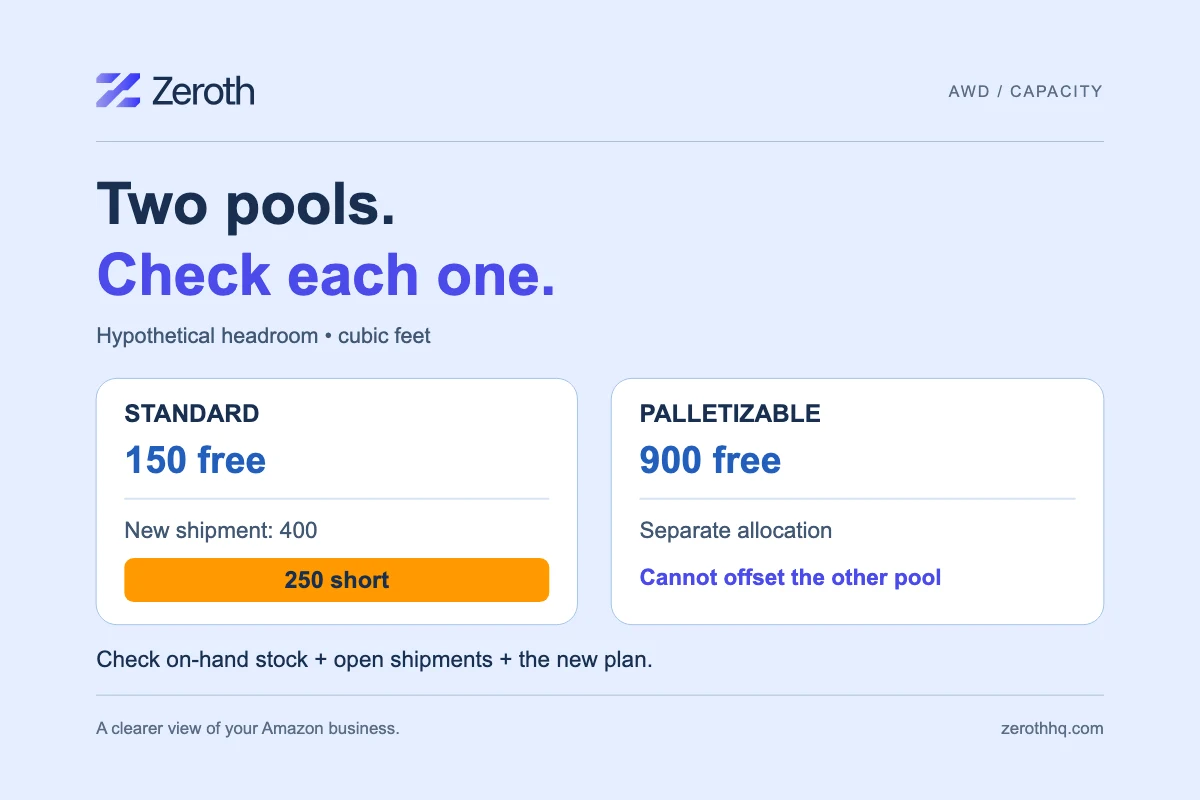
Here is an explicitly hypothetical snapshot, in cubic feet. It is not an Amazon allocation estimate.
| Planning input | Standard pool | Palletizable pool |
|---|---|---|
| Total capacity | 1,800 | 1,800 |
| On hand | 1,000 | 600 |
| Open shipments | 650 | 300 |
| Space before | 150 | 900 |
| New shipment | 400 | 0 |
| Space after | -250 | 900 |
For the standard proposal, the calculation is 1,800 − 1,000 − 650 − 400 = −250 cubic feet. Adding both pools together would make the plan appear comfortable while concealing that shortfall. Do not use the second column to erase a problem in the first.
The useful next question is which assumption can change. Is an old open shipment still real? Is the 400-cubic-foot proposal urgent in full? Is there a documented allocation increase, or only a request? Record the answer beside the number, with an owner and a review date.
Treat expected outbound depletion as a scenario until it appears in the system. Run one version with your expected depletion and another with none. If the plan works only in the optimistic version, preserve a fallback storage or shipment schedule before committing supplier freight. This is a planning check, not a guarantee of shipment acceptance or receiving speed.
A 250-cubic-foot gap is not a 250-cubic-foot reservation
The example’s small shortfall should trigger a comparison, not an automatic capacity purchase. A base-allocation adjustment and a storage reservation are different decisions. Check the account’s available options and terms before committing.
For a separate hypothetical reservation analysis, suppose you commit to 1,000 cubic feet for a full billing month but use only 600. Forty percent of the reserved space is idle. Let R be the applicable monthly base storage rate per cubic foot. The reservation component would be 1,000 × R × 1.05 = 1,050R, equivalent to 1.75R per occupied cubic foot in this simplified comparison.
That is arithmetic, not a quoted dollar rate or a forecast of your total AWD invoice. Other services and inventory can add costs. Use the actual regional rate, reservation dates and expected utilization to compare alternatives at the same time horizon. The lesson is that a modest premium on committed space can have a larger effect when much of that space remains unused.
Prepare a decision record this week
For each proposed shipment, write down its pool, volume, urgency and latest workable supplier date. Attach a dated allocation snapshot and reconcile open shipments against your own purchase-order plan. Keep requested capacity separate from approved capacity in the worksheet.
If your plan depends on a base adjustment, use Amazon’s linked requirements and submit a complete request before the window closes. Assign someone to check the outcome; sending a request is not confirmation that the January plan fits. Before creating the shipment, repeat the calculation with the current account figures.
Finally, connect space planning to stock planning. A shipment can fit yet tie up cash in inventory you do not need. Use a reorder-point calculation to test the quantity, and review the separate 2027 FBA fee changes when estimating downstream unit economics. Keep the capacity decision and the demand decision visible together.
Sources & further reading
- Amazon US help: AWD capacity management ↗Checked November 18, 2026
- Amazon US help: AWD storage reservation fees ↗Checked November 18, 2026
Sources support reported facts; practical recommendations are Zeroth’s analysis. Amazon features and availability can change.