Amazon’s US help page identifies November 11, 2026 as the customer-availability date for its latest virtual multipack pilot wave. The limited pilot targets selected FBA brand-owned products; there is no manual opt-in. Amazon’s virtual multipack guidance
The important question for a participating seller is whether the pack price leaves enough contribution after paying for every physical unit. Below is Zeroth’s analysis and a hypothetical worksheet for making that decision.
What the pilot changes
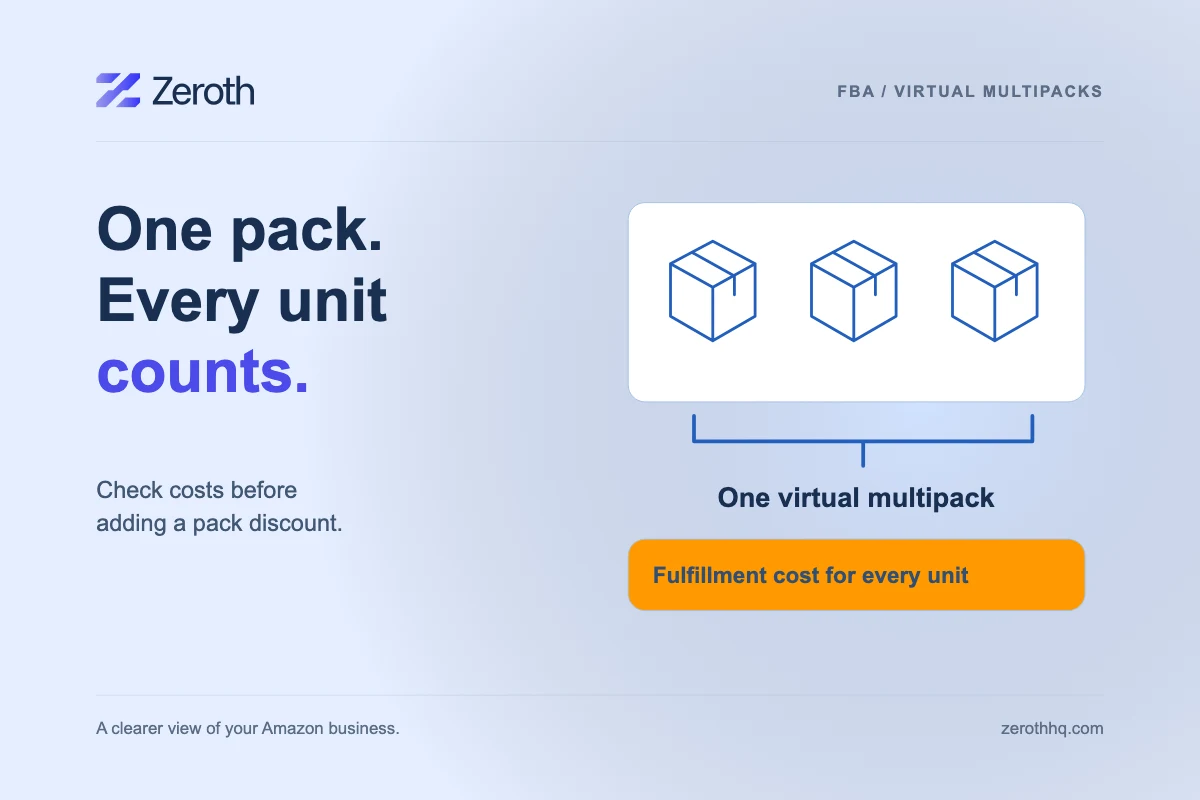
Virtual multipacks offer several units of the same ASIN using existing single-pack inventory. Amazon identifies their SKUs with VMP_. The pack price follows the single-pack price, with any pack discount applied; Amazon says updates generally occur within eight hours. Fulfillment fees are charged per unit: a two-pack incurs twice the single-pack fulfillment fee.
Amazon directs edits through Edit Virtual Multipack and warns that other editing routes can break the listing. It also says deleting a pilot listing prevents later reactivation. Check the current instructions before editing or deleting. Pricing, fees, and editing rules
Check your own catalog to establish whether you have a participating offer.
Build a pack-level contribution worksheet
Zeroth analysis: a pack is one customer purchase but consumes multiple physical units. Keep those two measures separate in your planning sheet. Start with a row for one single-unit sale and another for the proposed pack. Record:
- Single-unit selling price, pack quantity, pack selling price, and the discount assumption.
- Product cost and fulfillment cost for each physical unit.
- Other applicable selling charges using the correct basis for that charge.
- Advertising and promotional costs attributed to the sale.
- Contribution per pack, contribution per physical unit, and the minimum you want to retain.
Do not carry a cost into the pack column just once because the customer places one order. Conversely, do not multiply a genuinely order-level expense by the pack quantity. Label the basis of each input so someone else can reproduce the calculation.
Use a separate unresolved-input column. If you have not verified a fee, discount interaction, or cost allocation, the worksheet should show that gap rather than quietly treating the amount as zero. Our minimum-price contribution guide explains how to assemble the wider cost picture.
Worked example: a 10% discount cuts contribution by much more
Hypothetical illustration only. These are invented costs, not Amazon’s fee rates or a tested seller result. Assume:
- One unit sells for $20.
- Product cost is $7 and fulfillment cost is $4 per physical unit.
- For this example only, other variable selling costs equal 15% of revenue.
- Advertising, promotions beyond the stated pack discount, returns, and fixed overhead are excluded.
One single-unit sale contributes $6: $20 minus $7, minus $4, minus $3. Two separate single-unit sales therefore contribute $12 in this simplified model.
A two-pack at $40 also contributes $12: $40 minus $14 in product costs, minus $8 in fulfillment, minus $6 in the assumed revenue-based charge.
Apply a 10% pack discount and revenue becomes $36. Product and fulfillment costs remain $14 and $8, while the assumed 15% charge becomes $5.40. Contribution is now $8.60 per pack, or $4.30 per physical unit.
The selling-price discount is 10%, but contribution falls by $3.40 from the $12 baseline: about 28.3%. This is why a small-looking discount deserves a cost check before approval. The example does not establish whether the discount will create enough additional demand to improve the overall outcome.
Now assume your contribution target is $5 per physical unit, or $10 per two-pack. Under these exact simplified assumptions, the minimum pack revenue is:
($14 product cost + $8 fulfillment + $10 target) ÷ 0.85 = about $37.65.
That leaves room for roughly a 5.9% discount from $40, before any excluded costs. Round conservatively, then substitute your actual charges and allocations. This planning result is not a recommended discount for your products.
Convert pack orders into physical-unit demand
A separate inventory calculation prevents the sales forecast from understating consumption. Suppose your hypothetical forecast is 30 single-unit orders and 10 two-pack orders per day. That represents 50 physical units per day, not 40.
With 500 available units and no incoming stock, the simple cover estimate is 10 days. Counting every order as one unit would incorrectly suggest 12.5 days. Keep pack quantity in the calculation when reviewing reorder timing, and distinguish available stock from inbound quantities whose availability is still uncertain.
Use our FBA reorder-point guide to add lead time and a chosen buffer. The multipack worksheet should feed the same inventory plan as your single-unit sales, so the team has one physical-demand forecast to reconcile.
Distinguish DC case packs before comparing Business Prices
Amazon documents a separate distribution center case-pack pilot, with VMP_DC_ SKUs, using cases sent into FBA. Its US help page lists November 11, 2026 availability and says selection is at the individual-offer level, with no manual opt-in. An eligible ASIN does not make every seller’s offer eligible.
The important pricing distinction: the default case price uses the single-unit B2C price, even when the single unit has a lower Business Price. Amazon warns that this can leave the case more expensive per unit for business buyers. Amazon’s DC case-pack guidance
Zeroth analysis: classify the offer before applying a worksheet. A shared prefix or a similar inventory-screen label does not make the two pilots interchangeable. For a DC case offer, add a customer-price comparison alongside the contribution calculation.
A separate hypothetical example: suppose one unit has a $25 consumer price and a $22 Business Price. A six-unit case based on the consumer price starts at $150. Six single units at the assumed Business Price total $132. The case therefore costs $18 more, or about 13.6% more than that single-unit alternative. A 12% case discount would bring $150 down to $132.
Matching the alternative is only one test. Suppose the same example has $11 of product and fulfillment costs per physical unit, an invented revenue-based charge of 15%, and a contribution target of $8 per unit. Six units require $66 in costs plus $48 in target contribution. Minimum case revenue would be $114 ÷ 0.85 = about $134.12, before advertising, returns, fixed overhead, and any other excluded costs.
At $132, contribution would instead be $46.20 per case, or $7.70 per unit. Under those assumptions, matching the Business Price alternative misses the target. That is a reason to revisit the offer and inputs, rather than approve a discount solely because the case looks expensive. Verify the actual prices available to the same customer and quantity before drawing that comparison; this example does not establish which offers or discounts a particular buyer receives.
A focused catalog review
Our suggested next steps: identify whether your account actually has pilot offers, then choose one for review. Save the SKU mapping, displayed quantity, price, discount, and observation time. Compare the offer with the assumptions in your contribution worksheet and inspect whether the product images clearly communicate the quantity being sold.
Review any automation that could write to the pack listing against Amazon’s editing instructions. Do not assume a route used for ordinary SKUs is appropriate here. This article does not claim that Zeroth supports editing virtual multipacks.
After an allowed change, record the observed result and time separately from the requested change. Keep a named owner for follow-up if the displayed offer differs from the intended price or quantity. Treat deletion as a deliberate catalog decision after reading the pilot restriction, rather than a reversible troubleshooting step.
The first useful output is a small reconciliation: the offer customers see, the physical units it consumes, and the contribution your costs support. Expand that review across the catalog only after those three agree for the first offer.
Sources & further reading
- Amazon US help: Virtual multipacks pilot, pricing and fees ↗Checked November 13, 2026
- Amazon US help: Distribution center case packs ↗Checked November 13, 2026
Sources support reported facts; practical recommendations are Zeroth’s analysis. Amazon features and availability can change.